
Up to 40% off Best-Selling Furniture. Shop Now
How to organize your everyday bag with smart packing habits for work, college, and travel
September 25, 2026

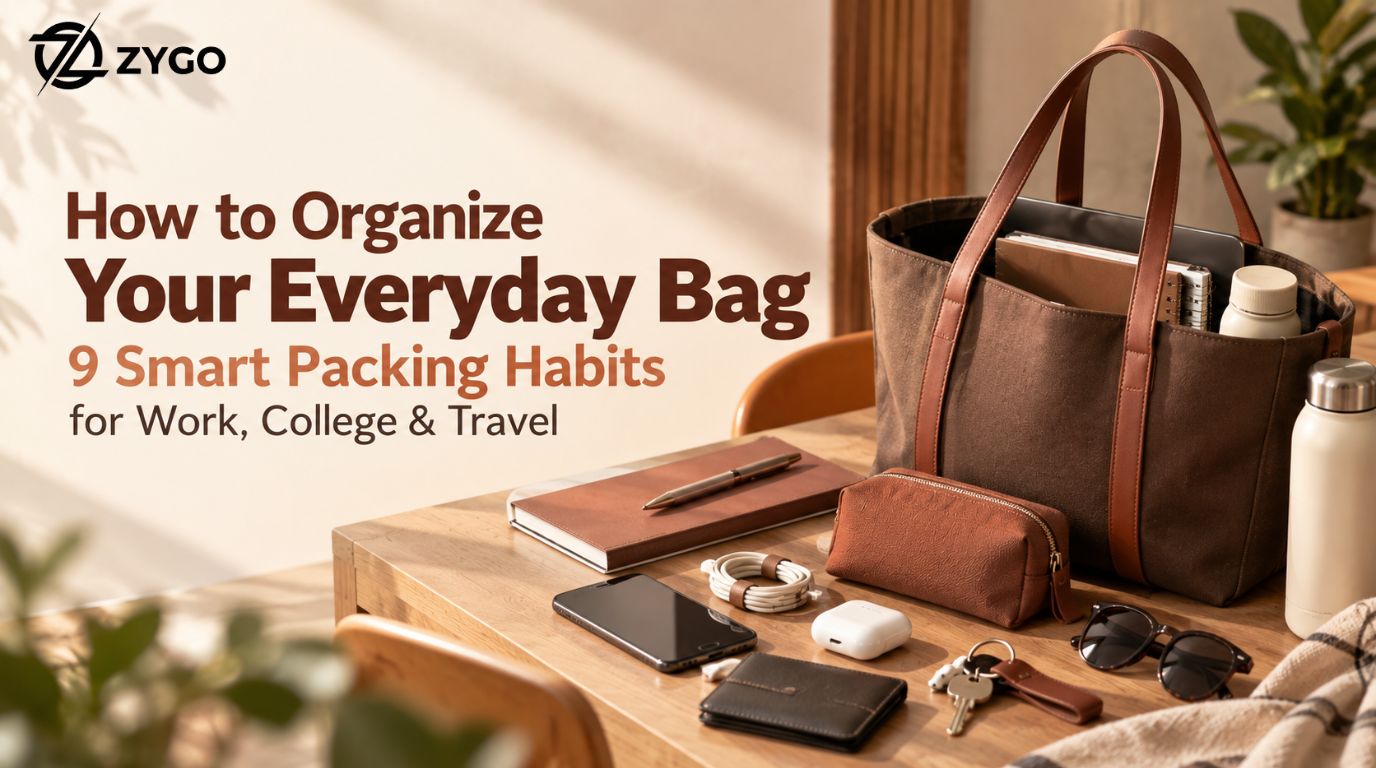
How to Organize Your Everyday Bag:9 Smart Packing Habits for Work, College & Travel

A bag can be spacious and still feel impossible to use when everything inside it competes for the same space. Keys disappear under notebooks, charging cables knot together, receipts collect at the bottom, and the item you need most somehow becomes the hardest one to find. Good bag organization is less about carrying more and more about giving every essential a clear role.

Whether you are packing for a workday, college, errands, a café session or a short trip, a few repeatable habits can make everyday carry feel lighter, calmer and easier to navigate. The goal is not a perfectly styled bag. It is a system you can reset in minutes and understand without thinking.

If you are still deciding what type of carry suits your routine, explore Zygo’s everyday bag collection and compare the format with the way you actually move through your day.

Why Everyday Bag Organization Matters

An organized bag reduces small points of friction. You spend less time searching, you can see what needs replenishing, and you are less likely to carry duplicates “just in case.” It also makes switching between work, college, shopping and travel simpler because the system can stay consistent even when the contents change.

A useful organization system usually does three things: it separates categories, keeps high-frequency items easy to reach, and leaves enough free space for the day to change. That last point matters. A bag packed to its limit may look efficient at home but can become frustrating the moment you need to add a document, snack, light layer or purchase.

1. Start With an Empty Bag

Before reorganizing, remove everything. Empty every pocket, shake out small debris, discard old receipts and check whether you are carrying expired passes, dry pens, duplicate chargers or items that belong somewhere else. This reset makes it easier to distinguish true essentials from things that simply accumulated over time.

2. Build Around Three Zones

Think in zones rather than individual objects. A practical everyday setup is: quick-access essentials, work/study items, and personal care or backup items. The exact pockets or pouches can change, but keeping the categories stable trains you to reach for the right place automatically.

3. Keep High-Frequency Items Near the Top

Keys, access cards, earphones, wallet and phone-related items should not live under a laptop sleeve or beneath a stack of notebooks. Place the things you use repeatedly in the most reachable pocket or upper section. Reserve deeper areas for things you may need only once or twice during the day.

4. Use Small Pouches for Small Things

Loose cables, coins, medication, grooming items and stationery are what usually create visual clutter. A small pouch can turn five or six loose objects into one easy-to-move unit. Zygo’s site currently includes pocket-friendly bags and coin-pouch formats, which suit this kind of category-based organization.

For a compact secondary carry option, see Zygo’s Foldable Tote Bags, designed to store compactly when not in use.

5. Give Electronics Their Own System

Keep charging cables coiled, avoid mixing them with pens or keys, and place power accessories where they can be removed without unpacking the entire bag. If you travel by air, battery rules matter: IATA notes that spare lithium batteries and power banks belong in carry-on baggage and may be subject to specific handling requirements.

For current air-travel baggage guidance, check IATA’s passenger baggage rules before flying because airline allowances and restrictions vary.

6. Pack Flat Items Against the Structure of the Bag

Notebooks, folders and tablets usually sit best against the broadest, flattest section of a bag. Keeping flat items together helps prevent corners from catching on smaller objects and makes the remaining space easier to use. Avoid forcing rigid items into a bag whose shape does not support them.

7. Leave a Little Empty Space

Good packing is not maximum packing. Keeping some usable space gives you room for a lunch box, a small purchase, a folded scarf or documents picked up during the day. A bag that begins the morning completely full has no flexibility when your routine changes.

8. Create a Separate “Just in Case” Kit

Backup items are useful, but they should not take over the main compartment. Keep a compact kit with only the items you genuinely use: perhaps tissues, a small sanitizer, a pen, a charging cable or a few personal-care basics. Review it periodically instead of continuously adding to it.

9. Do a Two-Minute Reset at the End of the Day

The easiest organization system is the one you can maintain. At night, remove wrappers and receipts, return misplaced items to their zones, refill anything that ran out and take out anything you will not need tomorrow. Two minutes of resetting prevents a week of clutter from building up.

A Simple Packing Order That Works

ZoneExamplesPacking Principle
Quick accessKeys, wallet, access card, earphonesUse the easiest-to-reach pocket or upper section.
Work / studyNotebook, folder, tablet, pensKeep flat items together and supported.
TechCable, charger, power bankContain cables and keep batteries accessible.
PersonalTissues, sanitizer, care itemsUse one compact pouch instead of loose items.
Flexible spaceSnack, scarf, documents, small purchaseLeave room instead of filling the bag completely.

How to Adapt the System for Work, College and Travel

For work

Prioritize quick access to ID, wallet, keys and tech accessories. Keep documents and notebooks flat, and avoid carrying duplicates of things already available at your workplace.

For college

Build around classes: notebook or folder, writing tools, charger and personal essentials. If your schedule changes daily, reset the academic section each evening instead of carrying every subject all week.

For short travel

Keep documents, medication and electronics accessible, and separate items that may need to be removed at security. Airline rules vary, so check your carrier before packing. IATA notes that carry-on size and weight allowances can differ by airline, cabin class and aircraft type.

For travel-specific screening preparation, the TSA travel checklist recommends beginning with an empty bag, reviewing restricted items, and keeping screening-sensitive items accessible. Travellers should also follow the rules of their departure airport, destination and airline.

The “One Bag, One Purpose” Test

Before leaving home, ask one question: does every item in this bag have a realistic job today? If the answer is no, remove it. This is especially useful when moving between different routines. A work bag does not need every travel backup item, and a café run does not need the full contents of a college day.

Zygo positions its Urban Everyday Tote Bag for work, college, shopping and daily use. Whatever bag you choose, treat the product description as a guide to intended use—not a reason to fill every available centimetre of space.

Explore the Urban Everyday Tote Bag for a current example of Zygo’s everyday-carry direction.

Quick Everyday Bag Checklist

  • Only today’s essentials are inside the bag.
  • Keys, wallet and access cards are easy to reach.
  • Cables and small items are contained rather than loose.
  • Flat items are stored together without bending.
  • Tech accessories are packed safely and accessibly.
  • There is some empty space for the day to change.
  • Receipts, wrappers and outdated items have been removed.
  • Travel-specific rules have been checked when flying.

FAQs

How do I keep my tote bag from becoming messy?

Use fixed zones, contain small items in pouches, keep frequent-use items near the top and reset the bag at the end of the day.

Should I use lots of organizers inside one bag?

Not necessarily. Too many organizers can create bulk. Start with one or two small pouches for the categories that actually become messy.

What should stay in an everyday work or college bag?

Keep only items you use regularly: essentials, work/study materials, required tech and a compact personal kit. Exact contents depend on your routine.

Is a foldable bag useful as a backup?

A foldable bag can be useful when you occasionally need extra carry space, provided the specific product suits the intended load and use. Zygo currently lists foldable and pocket-friendly bag options.

How should I pack differently for air travel?

Check your airline and airport rules before packing. Carry-on allowances vary, and some items such as spare lithium batteries and liquids are subject to specific restrictions.

Final Thought

The best-organized bag is not the one with the most compartments or the most carefully arranged flat lay. It is the one that supports your routine without demanding attention. Give essentials a consistent place, carry less of what you rarely use, leave room for the unexpected and reset the system before clutter builds up.

Explore Zygo for everyday carry options designed around work, travel, shopping and daily movement.

External References

IATA — Passenger Baggage Rules — current guidance on cabin baggage allowances, lithium batteries and baggage restrictions.

TSA — Travel Checklist — practical pre-packing and screening-preparation guidance for air travel.
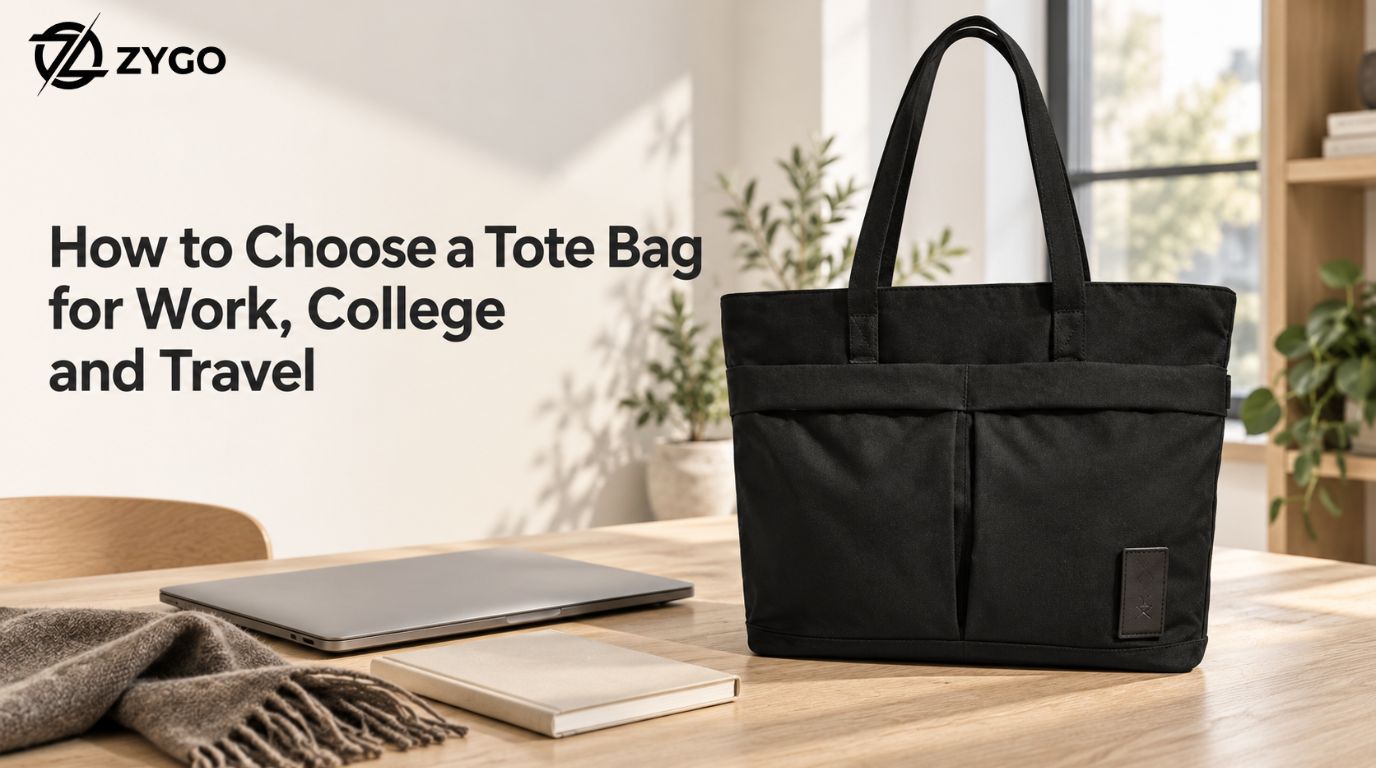
Black tote bag for work, college and travel with laptop and book
September 19, 2026

How to Choose a Tote Bag for Work, College and Travel

Your bag might leave home with a notebook and lunch, pick up a few errands after work, and finish the day beside a cafe table. That is a lot to ask of something you may have chosen mainly for its colour.

Knowing how to choose a tote bag starts with a less glamorous question: what do you actually need it to do? A roomy photograph is not enough. The opening, handles, usable space and small-item storage all deserve a closer look.

Whether you are comparing Zygo tote bags for work, college or a short trip, use this guide to shortlist a bag around your real routine, not an imaginary day when you carry everything you own.

The quick answer: Choose a tote that fits your largest everyday item, closes properly when packed, feels comfortable with your usual load and gives small essentials a reliable home. Then check the care instructions and choose a style you will enjoy using repeatedly.

Start with the day you actually have

Empty your current bag onto a table. Separate everyday essentials from occasional extras and things you have simply forgotten to remove. Your shortlist should serve the first group before making room for the other two.

A workday with a laptop and lunch needs a different layout from a light college day or a weekend away. Start with the routine that happens most often.

Your routineTypical essentialsWhat to check first
WorkLaptop or tablet, charger, notebook and lunchUsable device space, closure and room to separate food from electronics
CollegeBooks, stationery, bottle and personal itemsBook fit, comfortable handles and easy access between classes
Travel dayDocuments, phone, charger and a light layerSecure access, packed dimensions and the airline rules for your booking

Treat these as starting points, not packing requirements. Someone attending one lecture may carry less than someone commuting to an office; your actual contents should decide the size.

Measure the usable space, not the product photograph

A tote can look spacious and still have an opening that makes your largest item awkward to insert. Compare the internal width, height and base depth, then check the opening separately. Where a listing gives only overall dimensions, ask whether those measurements describe the outside or the usable interior.

For a laptop, measure the device inside the sleeve you plan to use. Check that this combined shape fits through the opening and leaves enough clearance for the bag to close. Do not rely on a screen-size label alone.

Also distinguish between a tote that can accommodate a laptop and one with a dedicated padded laptop compartment. Ask for an interior photograph when that feature matters. A general tote should not be assumed to provide device protection simply because a computer fits inside.

Finally, consider objects together. A lunch box and notebook may each fit separately but compete for the same space when packed. Your aim is a workable arrangement, not a list of items that fit one at a time.

Try the handles with a realistic load

An empty bag tells you little about how it will feel during your day. When you can try a tote in person, use a representative load and walk with it. Check whether the handles stay where you want them, whether the opening sits too close to your arm, and whether the bag gets in the way.

Handle drop is the space from the top of the handle to the top of the bag. Look for enough clearance for the clothes you normally wear. For an online purchase, ask for this measurement and a photograph showing the bag being carried.

Be honest about the commute, too. A tote you enjoy carrying on a short walk may not be your preferred choice for a long journey with books and equipment. Compare another bag format when your regular load feels awkward.

Match the closure and organisation to your routine

Think about the moments when you use your bag: reaching for keys at the door, finding a card at a counter or taking out a notebook between classes. Those moments are more useful design tests than counting pockets.

A zip, magnetic fastening and open top offer different levels of access and coverage. Try the closure with the bag packed, not empty. For crowded commutes or travel, you may prefer a fully closing top, but no fastening should be treated as a theft-prevention guarantee.

Give your contents three simple zones: a place for larger items, a place for small loose pieces and a consistent spot for things you reach for often. Keep the system simple enough to maintain when you are in a hurry.

If you prefer a spacious main compartment, organizer pouches are worth considering for cables, stationery or personal essentials. Check their dimensions against the tote, and avoid adding so many that the organisers become the bulk you were trying to remove.

Read the care instructions before choosing a material

Start with the product description, close-up images and care instructions rather than assuming that a fabric name tells the whole story. Check the outer material, lining, handle attachment and base. These are useful details to ask about when photographs leave questions unanswered.

Do not assume that a fabric tote is machine-washable or that a coated-looking surface is waterproof. Look for an explicit, product-specific statement. Ask what any water-resistance claim covers before relying on it to protect electronics or documents.

For textile care labels, GINETEX’s care-symbol guide explains washing, drying and other treatment symbols. Follow the instructions supplied for the complete bag, not a cleaning method chosen only from its outer fabric. Where instructions are missing, ask the seller before washing.

Choose a care routine you can realistically follow. That matters more than selecting a material because it sounds fashionable in a product description.

Check travel requirements separately

For a road trip or overnight stay, think about the items you need to reach without unpacking everything. Give travel documents and frequently used essentials a deliberate place, and check whether the tote still closes with a light layer added.

Flying requires a separate check. IATA’s passenger baggage guidance explains that cabin-baggage allowances vary by airline, cabin class and aircraft type. Check the current rules for your own booking, including the permitted number of bags, dimensions and weight.

Measure the tote as you intend to pack it. Do not assume that the label “travel tote” means it qualifies as an additional personal item or can accompany your other cabin bag without restrictions.

Choose a style that works more than once a week

Once the practical checks are complete, bring your wardrobe into the decision. Picture the tote with three outfits you already wear: perhaps an office look, a relaxed college outfit and your usual weekend clothes.

A neutral shade can be your choice for a quiet, coordinated look; a brighter colour can be the detail you build an outfit around. Neither is automatically more versatile. Choose the one that works with your clothes and feels like something you would reach for on an ordinary morning.

Pay attention to scale as well. Compare carrying photographs and measurements rather than judging the silhouette from a close-up product image alone.

Use the pack-and-go check before ordering

A final shortlist needs more than a favourite colour. Use these five questions to test a bag in person or identify what to ask the seller.

Fit: Can your largest essential go through the opening without force, with room for the rest of your usual load?

Closure: Does the bag close properly when packed the way you actually use it?

Access: Can you find keys, a phone or a charger without emptying the main compartment?

Carry: Do the handles and overall shape feel manageable for your normal journey?

Clarity: Are the dimensions, care guidance and current purchase terms clear enough for an informed decision?

Frequently asked questions

What size tote bag is best for daily use?

Choose around your largest regular item and the combined space your essentials need. There is no single ideal size for everyone. Check internal measurements, the opening and base depth rather than choosing only by labels such as medium or large.

Can I use a tote bag for work and college?

Yes, provided the same bag suits both loads and is comfortable for both routines. Compare book or laptop fit, closure and small-item organisation. On heavier days, reconsider what you need to carry rather than automatically filling every available space.

Do I need lots of compartments?

Not necessarily. Fixed pockets may suit someone who likes an assigned place for each item. A simpler interior with a removable pouch may suit someone whose contents change. Choose the arrangement that makes your essentials easy to find.

How can I check whether a Zygo tote fits my laptop?

Measure your laptop in its sleeve, then compare it with the specific tote’s usable interior and opening. If the product page does not provide enough detail, contact Zygo to confirm dimensions and whether that particular design includes padding before ordering.

Find your everyday tote with Zygo

Explore Zygo’s Urban Everyday Tote Bag and wider daily carry collection with your checklist in hand. Compare the options against your work, college or travel routine, and confirm the details that matter most to you before choosing.

The right tote is not necessarily the largest or the most eye-catching. It is the one that lets you pack what matters, find it easily and get on with your day.

What is the one item your everyday tote must always have room for? Tell us in the comments.

Search for products (0)

Back to Top
Product has been added to your cart